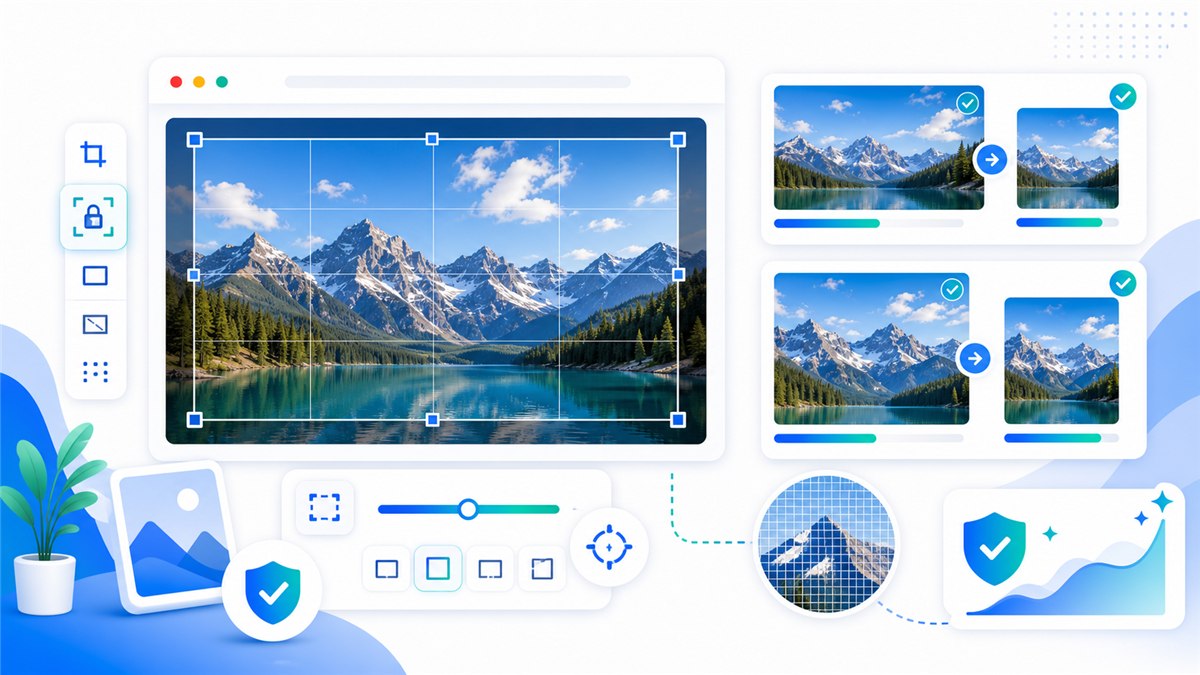
So änderst du die Bildgröße ohne Qualitätsverlust ist mehr als eine optische Anpassung. Es ist ein sauberer Prozess, um ein Bild für einen konkreten Zweck vorzubereiten und Kontrolle über Qualität, Dateigröße, Format und Datenschutz zu behalten.
Einleitung
Mit Resizo Image Resizer beginnt der Workflow beim Ziel: Webseite, Formular, E-Mail, Shop, Social Media oder vertrauliches Dokument. Danach legst du Abmessungen, Format und Qualität fest.
Was bedeutet dieses Thema?
Ein Bild ohne Qualitätsverlust zu skalieren bedeutet, die Pixelmaße des Bildes für ein konkretes Ziel zu ändern — eine Website, eine Produktgalerie, einen E-Mail-Anhang oder ein Upload-Formular — und das Ergebnis dabei sichtbar scharf zu halten. Die Qualität bleibt erhalten, wenn drei Regeln eingehalten werden: vom Original aus verkleinern statt vergrößern, das Seitenverhältnis beibehalten, damit nichts verzerrt wird, und nur einmal in einem Format exportieren, das zum Inhalt passt — also JPEG oder WebP für Fotos und PNG für Grafiken und Text. Der gesamte Workflow läuft auf vier Entscheidungen hinaus: Abmessungen, Format, Qualität und Datenschutz. Moderne Browser können alle vier lokal abwickeln. Die bei MDN dokumentierte Canvas-API exportiert PNG in jedem Browser sowie JPEG und WebP in den meisten — deshalb kann ein browserbasiertes Tool wie der Resizo-Bildgrößenänderer ein 5 MB großes Handyfoto vollständig auf deinem eigenen Gerät verkleinern, ohne Upload und ohne Server-Umweg.
Warum es wichtig ist
Beim Skalieren sorgfältig vorzugehen ist wichtig, weil Fehler teuer und leicht zu übersehen sind. Ein 5 MB großes Handyfoto, das direkt auf eine Website hochgeladen wird, bremst jeden Seitenaufruf; ein zu stark komprimierter Ausweis-Scan kann genau den Text unlesbar machen, den das Formular eigentlich braucht; uneinheitlich zugeschnittene Produktfotos lassen einen ganzen Katalog weniger vertrauenswürdig wirken. Die Ursache ist meist dieselbe: Das Bild wurde mit den falschen Pixelmaßen exportiert oder öfter als nötig neu komprimiert — und jeder zusätzliche verlustbehaftete Export fügt der Datei weiteren Schaden zu. Die Lösung ist prozedural, nicht künstlerisch: vom Original aus skalieren, das Seitenverhältnis gesperrt lassen, die Ausgabegröße an die tatsächliche Anzeigegröße anpassen und genau einmal in einem passenden Format exportieren. Weil der Resizo-Bildgrößenänderer Dateien lokal im Browser verarbeitet, statt sie hochzuladen, verlassen sensible Bilder wie Ausweise, Kundenarbeiten und unveröffentlichte Produktfotos nie dein Gerät.
Wichtige Vorteile
- You reduce wasted upload time because quality-safe image resizing happens before the file reaches a website, form, or CMS.
- You make the output predictable: exact dimensions, sensible file size, and a format that fits the destination.
- You protect the original image by exporting a separate optimized copy instead of editing the only version you have.
- You avoid common quality damage such as stretched aspect ratios, repeated compression, and unnecessary upscaling.
- You create images that are easier for users to download and easier for search engines to understand when combined with good filenames and alt text.
Schritt-für-Schritt-Anleitung
- Open Resizo Image Resizer and select the original image from your device.
- Identify the real target: website speed, email attachment limit, form upload, profile photo, or social image size.
- Set the pixel dimensions first. Reducing a 4000 px phone photo to 1600 px usually saves far more than quality changes alone.
- Keep the aspect ratio locked unless you are intentionally cropping to a platform size.
- Choose WebP for web use, JPEG for general photo compatibility, and PNG for transparency or screenshots.
- Start with quality around 75-85 for photos, then preview details before downloading.
Best Practices
Typische Fehler sind Uploads sensibler Fotos ohne Prüfung der Bedingungen, zu starke Komprimierung, verzerrte Maße und das zu frühe Löschen der Originale.
- Start from the highest-quality original you have. Resizing a bad copy usually amplifies blur and compression blocks.
- Set dimensions before quality. Pixel count is usually the biggest driver of file size.
- Use one export pass. Reopening and recompressing the same output again and again causes visible damage.
- Keep a small test set with different image types: portrait, product, screenshot, dark photo, and transparent graphic.
- Use descriptive names such as resized-passport-photo.jpg or product-main-1200.webp instead of IMG_4829-final-final.jpg.
Häufige Fehler
Für Teams lohnt sich ein Preset-Blatt mit Zielbreite, Format, Qualität, Dateinamen und Prüfschritten. So entstehen konsistente Exporte.
- Uploading sensitive photos to a tool before checking how the service processes and stores files.
- Forcing a fixed width and height that distorts people, products, logos, or documents.
- Upscaling a small source image and expecting true detail to appear. Upscaling can enlarge pixels, but it cannot recreate missing information.
- Using PNG for every photo. PNG is excellent for transparency and sharp graphics, but photos often become unnecessarily large.
- Ignoring the final use case. A print-quality master and a fast web preview are different files with different requirements.
Fortgeschrittene Tipps
Praxisbeispiel: Ein 4-MB-Handyfoto kann oft unter 700 KB landen, wenn es zuerst auf 1600 px Breite skaliert und danach mit ausgewogener Qualität exportiert wird.
- Create two exports for important web assets: a 1600 px master for large screens and a smaller 800 px version for thumbnails or cards.
- For ecommerce, make a consistent crop and background part of the process before compression. Visual consistency often matters as much as file size.
- For screenshots, test PNG and WebP. Text-heavy screenshots can look worse if compressed like ordinary photos.
- For forms with strict KB limits, resize dimensions first, then lower quality gradually in small steps.
- For private workflows, load the tool, disconnect from the internet, and complete local processing after the page is open.
Praxisbeispiele und Anwendungsfälle
| Scenario | Problem | Workflow |
|---|---|---|
| Job application | A phone photo is 5.8 MB but the portal allows 500 KB. | Resize the longest side to 1200 px, export JPEG at 78 quality, and check facial detail. |
| Online store | Thirty product images are different sizes and too heavy. | Batch resize to a consistent square canvas, export WebP, and keep originals archived. |
| Blog publishing | A hero image is 4032 px wide and slows the page. | Resize to 1600 px wide, export WebP, and add a descriptive filename and alt text. |
| Before | Action | Result | Why |
|---|---|---|---|
| Phone photo, 4032 x 3024, 4.8 MB | Resize to 1600 px wide and export WebP/JPEG at 80 quality | Often 250-700 KB | Best for blogs, portfolios, and basic web uploads |
| PNG screenshot, 2880 px wide, 2.4 MB | Resize to display size and test PNG vs WebP | Often 300-900 KB | Keeps UI text readable while removing oversized pixels |
| Product image set, mixed dimensions | Batch resize to consistent canvas and rename files | Consistent gallery assets | Improves UX and avoids layout jumps |
Empfohlene externe Quellen
- MDN HTMLCanvasElement.toBlob - Explains how browser canvas exports image blobs, formats, and quality settings.
- web.dev Learn Images - A practical reference for web image formats, responsive images, and performance.
- Google Image SEO Best Practices - Google guidance for discoverable images, alt text, structured data, and fast image pages.
Häufig gestellte Fragen
What is How to Resize an Image Without Losing Quality?
How to Resize an Image Without Losing Quality is a practical workflow for resize an image while avoiding blur, pixelation, distortion, and bad compression. The goal is to create a smaller or better-fitted image while preserving the details that matter for the destination.
Can I do this with Resizo Image Resizer?
Yes. Resizo Image Resizer is designed for this exact workflow. You can choose dimensions, format, and quality settings, then download an optimized copy without changing the original.
Does Resizo upload my images?
For supported Resizo browser tools, the image is processed locally in your browser. That means the original file stays on your device during resizing, compression, conversion, and preview.
What format should I choose?
Use WebP for most modern web pages, JPEG for broad photo compatibility, and PNG when you need transparency, sharp UI graphics, or exact screenshot detail.
Will reducing file size always reduce quality?
Not always in a visible way. If you reduce unnecessary pixels first and use sensible quality settings, the file can become much smaller while looking the same at normal viewing size.
What quality setting is best?
For photos, start around 75-85 and inspect the result. For screenshots or graphics, test PNG and WebP because ordinary photo compression can make text and edges look rough.
Can I process many images at once?
Yes, especially for batch workflows. The practical limit depends on your browser and device memory because local tools use your own machine rather than a server queue.
Should I delete the original after exporting?
No. Keep the original until the final image has been uploaded, reviewed, and approved. Store optimized exports in a separate folder so you can regenerate them later.
How do I avoid blurry output?
Do not upscale small files, keep aspect ratio locked, export from the original, and check the result at 100 percent zoom before using it in production.
Is this good for SEO?
Yes when combined with fast file sizes, descriptive filenames, useful alt text, proper HTML image elements, and relevant page content near the image.
Fazit
Fazit: Starte beim Einsatzzweck, schütze das Original und prüfe die Ausgabe. Resizo macht diesen Workflow schnell, kontrollierbar und datenschutzfreundlich.
So änderst du die Bildgröße ohne Qualitätsverlust
Praktischer Resizo-Leitfaden zu so änderst du die bildgröße ohne qualitätsverlust mit Schritten, Fehlern und No-Upload-Workflow.
Resizo kostenlos testen